

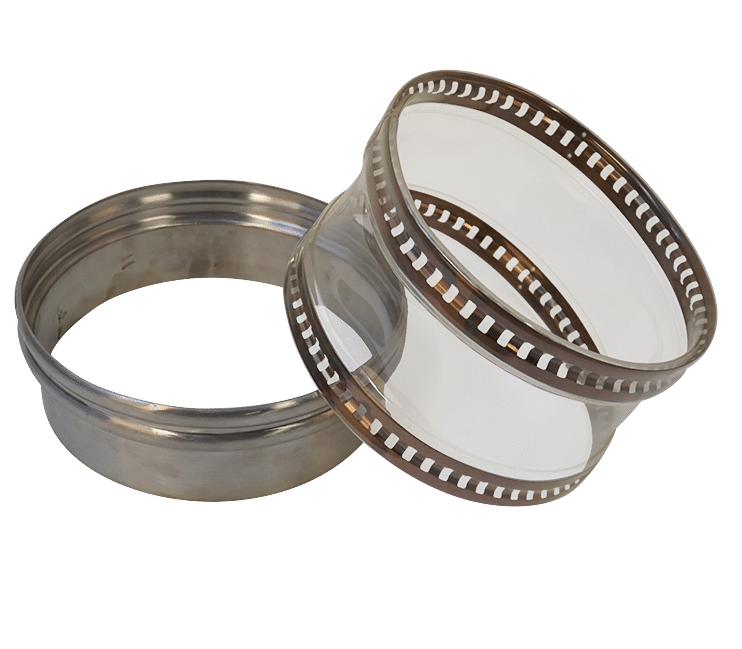
With a flexible cuff you can absorb movement in industrial systems
Flexible cuff
A flexible sleeve allows you to absorb movement in industrial systems. Movement is inevitable. Pipes and equipment expand, vibrate, or shift under the influence of temperature, pressure, or mechanical stress. A flexible sleeve ensures that these movements are controlled without compromising the seal or connection. This keeps your system running safely, efficiently, and with minimal maintenance.
Request a quote
What is a flexible cuff?
A flexible one cuff is an elastic connection that connects two pipes, equipment, or ducts airtight and flexibly. Thanks to the use of high-quality materials such as EPDM, NBR, silicone rubber, or textile-reinforced PVC, the sleeve can absorb axial, lateral, and angular movements. This makes this solution ideal for applications where minor misalignments, vibrations, or pressure fluctuations occur. Depending on the process, the sleeve can be made in various shapes and materials. For example, rubber cuffs often used for air and water transport, while PTFE cuffs or fabric cuffs are more resistant to high temperatures and chemical loads.


Request a quote for your technical specifications
Technical specifications and applications of elastic cuffs
Each installation has different requirements regarding temperature, pressure and chemical load. That is why flexible cuffs completely custom-made Designed and produced. During the design process, we consider:
- Temperature range: from –40 °C to +250 °C, depending on material type
- Workload: up to 10 bar, with options for vacuum applications
- Movement type: axial, lateral or angular rotation
- Medium: air, dust, gas or liquid
- Choice of material: rubber, PTFE, PVC, silicone or textile reinforcement
- Connections: flanges, clamps, plug-in or welded connections
This flexibility in design and production allows us to offer a solution that perfectly matches your installation, regardless of its complexity or environment. Flexible sleeves are widely used in sectors where reliability and continuity are crucial. Consider, for example, chemical industry, power plants, food processing, bulk transport en climate technology. In air-conditioning systems they provide a vibration-free and airtight connection between ducts, while in process pipes absorb expansion and pressure differences.
Vacancy

Internal sales representative
You look for opportunities in the market and respond proactively. You advise the customer, translate requests into quotes and follow up on these.
News

Range of weighing bellows expanded
For dust-free loading of bulk goods, a flexible sleeve is used in weighing and dosing equipment to create a tight connection.
News

5 disadvantages of double-layer flexible connections
The idea is that double layers reduce the chance of flammable substances being released. However, this assumption is incorrect.
❮
❯
Schedule a consultation
Our strength lies in technical knowledge and personal guidance. Whether you want to optimize an existing installation or connections If you're designing a new system, our engineers are happy to help you consider the use of the flexible sleeve. We'll assist you with material selection, construction advice, and installation instructions, ensuring a durable and safe solution. Schedule a consultation with one of our engineers.